
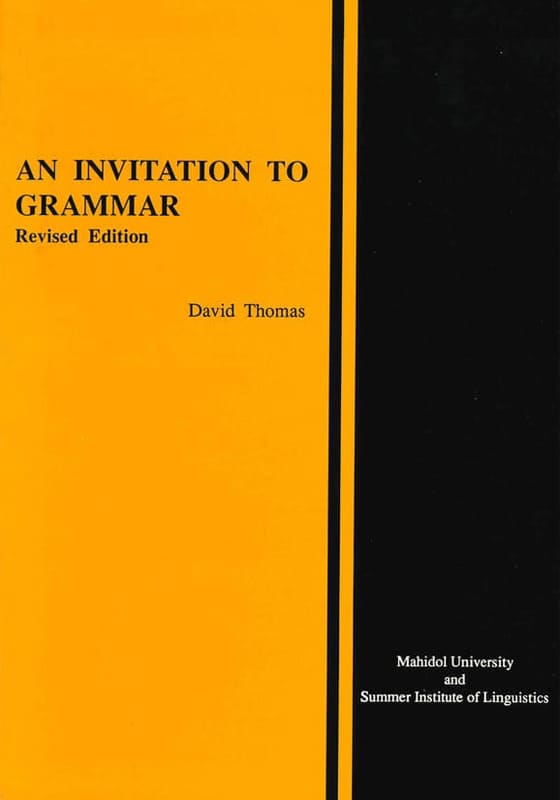
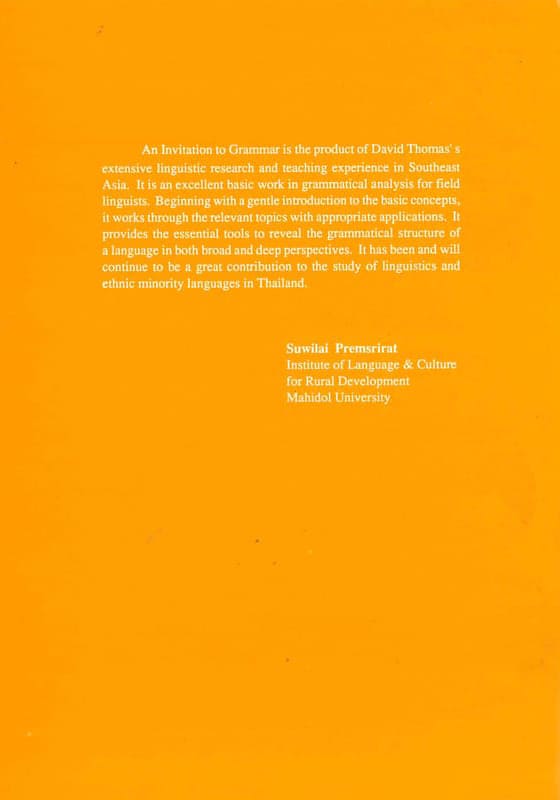
An Invitation to Grammar
฿100.00
มีสินค้าอยู่ 79
This revised edition is beina issued ten years after the first edition. Some major improvements include the filling out of the chapter and components outline for discourse to match the other sections, the addition of a chapter on the verb word, and the addition of outlines of the components of minor phrases. Other smaller improvements have been made throughout the book. We hope that readers and students will find this revision more helpful than its predecessor.
Some theoretical points
This book presents grammar from what might be called a basically tagmemic point of view, that is (1) structural emphasis is placed on both classes and slots (functions), (2) Language is conceived of as hierarchical in its organization and perception, (3) units are considered real, insofar as we can find them, not just imposed creations of the analyst, (4) language is seen as a basically human (not mathematical) activity, with its atendant redundancies, shortcuts, and fuzzy borders. Yet it is hoped that the presentation is sufficiently general to be of use to anyone interested in language. Indulgence is requested for my idiosyncrasies.
The hierarchical ranks are set up as a universal minimum. It would seem that semantics can be adequately and appropriately handled by these ranks. Structurally some languages may require additional ranks. Layering and recursive embedding within a rank are of course normal, and may sometimes become quite complex.
An attempt has been made to avoid metaphorical terminology as far as possible, so that the reader can fit the material more easily to his own metaphors. There is no discussion of the relative merits of algebraic, 4-box, 9-box, tree, wiring network, flowchart, arc, or other notations; presumably all can be made to handle the material.
Semantic labels are often used for structural slots. Where structural and semantic categories match, identical labelling simplifies the description. Yet care must be taken lest this blur the difference between structure and semantics.
This course is written as a logical presantation progressing from the morpheme to the discourse; but in oral teaching one may wish to start with the noun phrase, tossing in morpheme concepts as needed; and in a written description for practical language learning some may prefer to start with the clause, as most immediately useful.
An automatic following of the descriptive methods suggested here will lead to a heavily redundant description. Yet it is perhaps good for a beginner to “overkilI” the description at the start, Simplifying it later after he really understands it.
Format and presentation
National languages are cited in their common roman forms, or in an accepted romanized form of their own script. Minor languages are generally cited in a semi-phonemic form. ( A linguist may be expected to know the general pronunciation rules for major romanized languages but not for minor lanquaqes.) Underlining is used for cited forms, single quotes for specific meanings, no marking, general meanings.
EnglIsh and other language examples and formulas are illustrative only, not exhaustive, so there will be many unstated exceptions and restrictions to the rules and formulas given. And indeed, seldom in any real language does a rule or formula work fully and exhaustively.
The translation comments at the end of each chapter are neither detailed nor exhaustive, but it is hoped that they will point the way for the student who wants to make practical use of what he is learning. Similarly with comments on universals.
Slot names are generally capitalized, class names not capitalized.
When the structure, function, and semantics of a unit are from ditterent ranks. the unit is generally mentioned at its function and ite semantics. but it is treated most fully at the rank of its structure.
Most chapters follow the sequence I. structure,2. functions, 3. semantics and pragmatics, 4. transformations, 5. typologies and universals, 6. translation comments.
This course is presented hierarchically ,but the parallel within each chapter should make it possible for any who wish to study grammar by topics rather than by ranks to do so.
The book is designed for an intensive one-semester graduate course. Shorter courses may wish to take just the basic structures and semantic nuclei, leaving the complexities, compounding, details and transformations for optional reading.
A number of collections of grammar exercises are available today,each with its strengths and its weaknesses. The following collections are cited in the exercise section at the end of each chapter: Daly (Daly et al. 1981), Gle. (Gleason 1955), Merr.(Merrifield et al. 1974). Lar. (Larson 1975), Pike (Pike & Pike 1977), SILE (SIL England 1977). In addition, Mahidol staff (Mah.)have contributed new problems,sample solutions to old problems, and a sample blank grammar following the lines of this book; these are available from the Institute for Language and Culture for Rural Development, Mahidol University. Banakok, Thailand. 10700
| น้ำหนัก | 0.267 กก. |
|---|---|
| ขนาด | 23 × 17 เซนติเมตร |
| ผู้เขียน | |
| ปีที่พิมพ์ | 2536 |
| สำนักพิมพ์ | Printing Division, Asean Institute for Health Developement, Mahidol University |
| จำนวนหน้า | 163 หน้า |
สินค้าที่เกี่ยวข้อง
-
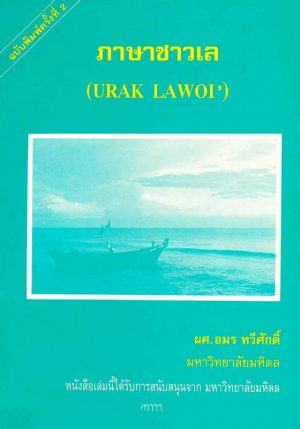
ภาษาชาวเล
฿75.00 -
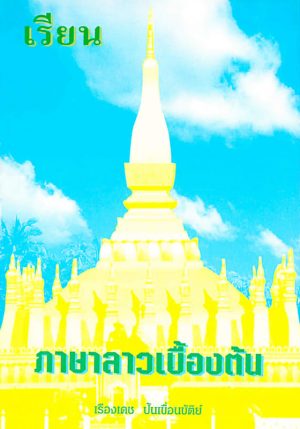
เรียนภาษาลาวเบื้องต้น
฿70.00 -
วากยสัมพันธ์
฿250.00 -
Kam-Tai Oral Literatures
฿90.00 -
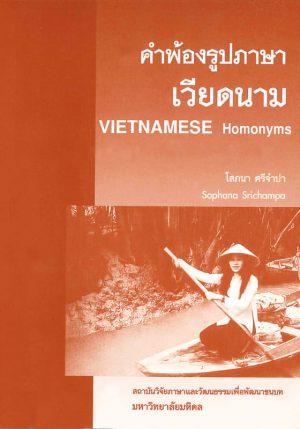
คำพ้องรูปภาษาเวียดนาม
฿150.00 -
วัจนปฏิบัติศาสตร์เบื้องต้น
฿250.00